
 Playlist du mois
 Bibliothèque musicale


Adolphe Biarent (1871-1916)
Il est élève au conservatoire de Bruxelles et de Gand. Un Prix de Rome obtenu en 1901 lui permet de découvrir l’Italie et surtout l’Autriche et l’Allemagne sur les traces de ses maîtres préférés, Beethoven et Wagner. De retour en Belgique, il donne à Charleroi un rayonnement culturel et musical. Son œuvre qui doit beaucoup à Franck et Wagner est tournée vers ses contemporains allemands (R. Strauss en particulier) et autrichiens.
Malgré toutes ses influences, nous avons à faire "une des personnalités parmi les plus fortes et originales de nos régions" (dixit les connaisseurs de lamediatheque.be)
"Au milieu des années 90, Biarent a été redécouvert par le musicologue Michel Stockhem qui propose à Pierre Bartholomée d’enregistrer Trenmor ainsi que sa Symphonie pour le label Musique en Wallonie. « A l’époque, j’ai consulté, déclare Bartholomée, les encyclopédies musicales, découvrant avec stupéfaction qu’un compositeur d’une telle qualité n’y figurait pas ». Le disque sort en 1996. Il sera suivit d’une seconde gravure parue cette fois chez Cypres en 1998, avec entre autres les Contes d’Orient."
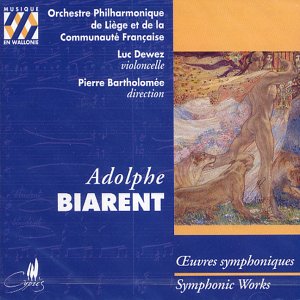
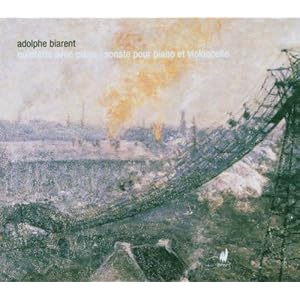
Voici ces deux disques :
Ce disque contient l'autre grande symphonie en ré mineur du répertoire belgo-français... ainsi que Trenmor (poème symphonique) et deux sonnets pour violoncelle et orchestre.
On peut écouter un extrait de Trenmor ici :
edit lien :
Le lien fourni ne fonctionne pas; pour écouter cet extrait, il faut aller sur :
http://blog.opl.be/index.php?id=blog50
et entrer Trenmor dans la petite fenêtre de recherche
Phil
Les pièces de résistance sont les Contes d'Orient et la Rhapsodie Wallone (qui n'a rien à envier à la Cévenole d'Indy, d'ailleurs ce dernier créa l'oeuvre de Biarent). On peut écouter partiellement ces oeuvres sur youtube :
Petit commentaire amazonien assez éclairant :
The rediscovery of the music Adolphe Biarent (1871-1916) might be one of the most important, however. This is gloriously autumnal, atmospheric late-romanticism; colorful and luminescent, and containing breathtaking themes and gorgeous textures.
The music has a certain escapist quality to it - this is music to lose yourself in; evocative, dreamlike, but often fiercely dramatic. Franck, d'Indy and Fauré are obvious models, and if you mix these three with Rimsky, Rachmaninov and Stenhammar you may get somewhere in the vicinity of what this music sounds like. It relies on the solid, cogent structural frameworks of Franck and d'Indy, but Biarent's textures are clearer and more refined (the scoring is brilliant). There is nothing very original in here, I admit, but with music as inventive and wonderfully constructed as Biarent's that surely pales into insignificance.
That said, if you are unfamiliar with his music I would recommend starting with his symphony, before moving on to the piano quintet and cello sonata. While the music on this disc is enjoyable, often gorgeous and melodically memorable, it does not quite reach the exalted levels of said masterpieces. Poème héroïque is still a fine work, developing from a stirringly dramatic opening to a wonderfully satisfying, noble close. The Rapsodie wallonne is rather slight. Scored for piano and orchestra, it is certainly airy and bright and atmospheric, but contains little but easy charm. Contes d'Orient is a suite consisting of 11 brief movements (and a long finale). While it is not in any way profound, it offers plenty of wonders and firework; yes, this kind of pseudo-orientalism is still thoroughly unfashionable, but Biarent's lush and perfumed sceneries offer plenty to savor for anyone who does not think that all music has to be about existential angst.
The performances are also very good; Diane Andersen is a fine soloists in the Rapsodie and the orchestral playing is really superb throughout under the sympathetic direction of Pierre Bartholomée. The sound has depth and warmth aplenty. In short, while this is close to a five-star disc, I still do not think this is the place to get to know the composer. If you have already heard the symphony, however, you should really not hesitate to acquire this one as well.
Les deux disques symphoniques sont également disponibles dans le cube consacré aux 50 printemps de l'orchestre de Liège.
Ce disque présente un splendide quintette pour piano et cordes (du calibre de ceux de Brahms et Franck) et la sonate pour violoncelle et piano.
Petit commentaire d'un internaute norvégien et amazonien :
I admit to having a penchant for exploring musical byways and rarities, but I do think that I am able to make more or less sober assessments of what I come across. Still, there seems to be no way around the fact that the music of the Belgian composer Adolphe Biarent (1871-1916) represents a major discovery of a composer whose negligence is wholly unjustified. Fortunately his music has received a couple of recordings the last couple of years - in fact, both works here have, as far as I can see, alternative recordings (although I haven't heard them) - and hopefully more will follow.
The cello sonata really deserves a place in the standard repertoire and doesn't pale at all in the company of, say, the Debussy or Rachmaninov sonatas. It is a large-scale, big-boned work that owes something to Cesar Franck and d'Indy, both formally and harmonically, but is fully individual and magnificently laid out for the instruments; gorgeously opulent and vibrantly dramatic, it doesn't contain a single dull or unmemorable moment or idea during its 35 minutes. Similarly, the piano quintet is inventive and thematically strong; Brahms and Franck are clear influences (but the quintet doesn't really sound anything like the piano quintets of either composer), wonderfully melodic and with a dramatic tension and energy beyond comparison. It contains no real slow movement, but consists of two huge, dramatic outer movements flanking a short, evocative intermezzo.
Fortunately the performances are superb; Diane Andersen comes across as a fabulous chamber musician, impressively sensitive both to the musical lines and the chamber textures. In the cello sonata Marc Drobinsky is unfazed by the technical challenges, playing with a rich tone and fully conveying the shattering drama of the music, whereas the Danel Quartet is equally excellent in the quintet. It is all captured in vivid, detailed sound and a delectable packaging. Very, very strongly recommended.



 Répondre avec citation
 ), je présente encore deux extraits de films avec musique de Jaubert : l'un est tiré de L'Atalante (Jean Vigo), l'autre est le générique d'Hôtel du Nord (Marcel Carné).
  ).
). ) !
) !
 Envoyé par joachim

 ...
...
 ).
).




 Haut
Haut